I found the easiest way to collect data was through a survey. My survey contains questions on both my topic, of young girls growing up too fast, and on the conventions of documentaries such as narrators (both on screen and off screen) and interviews.
I posted my survey on a student forum and hope to get many responses that way.
However I also, thought it to be a good idea to email some research companies and find out how they conduct their research.
This advert, takes up the whole double page spread of the news paper and is filled with the characters from Downton Abbey, in a family portrait manor, however all looking very suspicious. The suspicious facial expressions, the broken frame and the tag line "A House Divided" gives the audience some early idication of the plot. A tag-line is something conventionally used in newspaper adverts and something I wish to use in my own.
The lack of information on many newspaper adverts, for TV programs, including this one, is very conventional. This leaves it open to interpretation by the audience and gives them scope to go and watch the program in order to find out more.
Another convention of newspaper adverts, is to include the time, date and television channel which the program would be broadcast. This gives the audience valuable information as they would not ab able to view the program with out it.
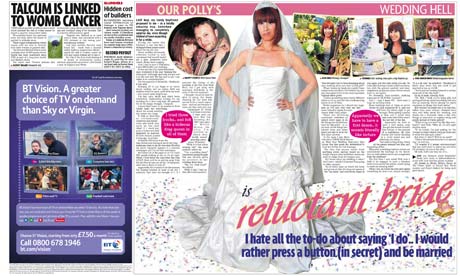
Although this double page spread is also from Radio Times, it is very different. It uses one main image of the subject of the article, in the center of the page and many smaller images in order to set the scene. This draws the eye to the images before reading the text. This is a technique used to shock the audience and draw them in. I would like to use this technique in my own work as I would like my message of children growing up too fast to come across in all three of my media texts.
As unconventional as the layout of this images is the text has been laid out in columns which is conventional of all magazines. The font used on the pull quote is bolder and surrounded by a pink speach bubble, which shows the audience this quote is important to the article. A drop capital is also used in the article, which is at the start of the article. This double page spread is not advertising a TV program, however the conventional use of bolder text at the begining in order to set the sceen is something I wish to use in my own work.
The representation in this double page spread, of a young, 20-30 year old woman, is completely different to my own, which will be that of young girls who are interested in make up. However this representation would in some way attract a similar audience to my own.
Top Gear presenter James May dicusses his mew TV program, Man Lab. He also talks about what its like to work with Jeremy Clarkson.
Analysis:
This double page spread uses one main image on the right hand page with all the text on the left this is a convention commonly used in double page spread and on which I had used in my own coursework at AS level. Although this makes it simple and easy to understand for the audience, it is not as attention grabbing as I would prefer mine to be.
The text has been laid out in three columns which is conventional of all magazines. The font used on the pull quote is larger than the main blocks of text and is also seperared by borders which shows the audience this quote is important to the article and the TV program it is advertising. A drop capital is also used in the article, which is at the start of the article. Drop capitals are commonly used at the start of articles in magazines, to indicate the start of a new topic.
The representation in this double page spread, of a middle aged man, is completely different to my own, which will be that of young girls who are interested in make up. The different representations would lead to a different target audience. The target audience in this double page spread would be that of men around the same age of James May himself, who know who he is and the type of work her does.
Barbie, is a 7-year-old girl. Whose mother Samantha spends every last penny on keeping Barbie in pink frilly dresses. Samantha noticed that from a young age Barbie enjoyed posing for the camera so decided to launch her modelling career. She has even spent hundreds if not thousands turning their home into a pink, Barbie palace. She has pink carpets and the kitchen is filled with 22 ornimental cupcakes and pink pots and pans.
Analysis:
The article contains nine pictures of Barbie and her mother, starting from the center and spreading out to both bottom corners, with the largest, main image in the middle. This to me suggests that Barbie loves to be center of attention.The use of pink directly relates to the contents of the article, in which its talks about Barbie's love for all things pink and sparkly.
The use of pink and so many pictures of Barbie, shows the audience just how young she is, and gives them the exact message that the writer was trying to commumicate, that is the same as my own documentarty and supporting tasks. Although this double page spread is not from a listing magazine, the target audience would be much the same as my own documentary, that of young to middle aged mothers with young daughters themselves. I also chose to use a similar layout to the one which this article uses, as although it doesn't contain much information there is still enough to inform the audience of what the documentary includes.
Title: The sex education show: Stop Pimping our kids
Source: Channel 4
Date: 11/04/2011
Synopsis:
Anna tackles high street giant Primark over children's clothing that
transforms kids into sexualised mini adults, and takes Matalan to task
over their decision to keep stocking padded bras in the children's
section.
The programme takes a look at what kids actually think of
padded bras at a pamper party, where little girls get fake tattoos and
drink fake champagne; and Anna receive a frosty reception from clothing
store security guards when she attempts to present them with an award
for inappropriate kids' clothing.
Anna and sexual health expert Dr
Radha Modgil are also back on tour in the nation's schools with the Sex
Education Roadshow and they'll be answering hundreds of questions from
the nation's teenagers about sex.
With fully interactive anatomy
classes, they will be looking at the male body in the biggest age range
ever of nude models - from 18 to 70 as we reveal how the body changes
from boy to man.
Anna will be undoing the damage done by the
playground rumour mill in a myth-busting workshop; seeing condoms tested
to their safety limits; and there's a parents evening with a difference
with a surprise family get together to find out how the rules on dating have transformed in a generation. And there's a second surprise in store when the grandparents arrive!
Analysis:
The open sequence of this documentary contains the on-screen narrator walking through the high street surrounded by high street shops and in particular Primark. The use of the on-screen narrator give the documentary a more factual feel. Not only this, but the use of an on-screen narrator also makes the documentary more forceful as it shows someone has taken the time to put there point across and do so personally.
The on-screen narrator in Stop Pimping Our Kids and the voice over in Baby Beauty Queens should me that for my documentary to be successful a narrator of some sort was essential. However the lack of interviews with the children themselves lacks empathy. The footage of the busy high-street, faded in to the background with the researched facts over the top makes the documentary more factual feel.
There are various different representations within Stop Pimping Our Kids. There are the representations of the young children between the ages of 3-13 (usually female), first and foremost, who are represented as the innocent victims of society and being forced into wearing clothes that are far too mature for their age. There are then very different representations of parents, again mainly females, on one hand theres the parents who are discusted but what others dress their children in and on the other hand there are those who see nothingwrong with it and are therefore looked down upon by the documentary makers.
Finally there is the representation of the shop owners, usually male and rich, these are represented as slimy and distrustful. This representation of the owners is stereotypical for this genre of documentary. Much like with Baby Beauty Queens, Stop Pimping Our Kids is targeted at a niche audience of mainly of mums from all demographic groups, who could bring their own analysis of the program they could either watch it and relate to the parents or watch it in discust, the main reason it was broadcast on BBC3 rather than a main stream channel, however the presenters forceful attitude and condisending tone usually makes the audience disagree with the shopkeepers choices.
In Stop Pimping Our Kids is that high street shops are putting, childrens clothes on sale that would be more at home in the adult section, and that it needs to change as its forcing children to grow up too fast. The narrative of Stop Pimping Our Kids is the narrator, Anna tracking down the shop owners and them if they think its appropriate to sell the products that they do or if they even know what they're selling. Eventually giving out a "worst shop award".
In 2004, Cyntoia Brown was arrested for the murder of a 43-year-old man.
Cyntoia was a prostitute and he was her client. Film-maker Daniel
Birman was granted unique access to Cyntoia from the week of her arrest,
throughout her trial and over a period of six years. His documentary
explores the tragic events in her life that led up to the murder, and
Cyntoia's biological mother meets he daughter for the first time since
giving her up for adoption 14 years earlier.
The film explores the
history of abuse, violence, drugs and prostitution back through three
generations. As Cyntoia faces a lifetime in prison, the programme asks
difficult questions about her treatment by the American justice system.
Analysis:
This Documentary shows the sexualisation of a young girl, which in a very small way links to topic of my own documentary about young girls growing up too fast. The high camera angles in the beginning of the documentary show Cyntoia to be very young and vulnerable however this changes in the second half of the documentary when she realises what she has been trough is wrong. Which is similar to what I wish to achieve.
Apart fron dialogue and voice over there is very little sound in this documntary, this forces its audience into listening to Cyntoia's story. As to does the setting, dispite being set in a prison, which is automatically shocking for the audience, the setting is very plain and so her orange suit stands out even more.
The use of the high angle shots, looking down on Cyntoia shows the audience her obvious youth. This paired with narrative again reiterates the point of my project, That children are growing up too fast.
As the American phenomenon of the children's beauty pageant hits the
UK, this documentary uncovers a surreal new world where nine-year-olds
get fake tans and seven-year-olds wear contact lenses.
With the
grand final of the first-ever Mini Miss UK beauty contest taking place
at a leisure centre in Milton Keynes, it soon becomes clear that
tantrums and tiaras may prevail over perfect poses and pouts. The
mastermind behind the pageant is a middle-aged ex-beauty queen, who
plans the entire event from her stairwell in Colchester.
The film
follows three girls and their mothers in the lead-up to the big event,
and as they prepare to dazzle the judges the real reasons why they are
desperate to be crowned Mini Miss UK become apparent. From the
evangelical Christians who are convinced that God will help them win the
pageant, to the disadvantaged kid for whom the contest holds the key to
a better life, the film portrays an eccentric, and at times disturbing,
snapshot of modern Britain.
Analysis:
The open sequence of this documentary contains images of young girls getting made-up like adults, getting spray tans and dancing, sometimes, provocatively. The voice over during this sequence gives this doumentary a factual feel and makes the audience believe in this representation of young beauty queens. The close up shot of a young girl named Maddisons face covered in make-up, paired with Maddisons voice narrating over the top, makes the audience connect with her and realise just how young she is. The shot of Maddison sitting in her room, playing with her toys again shows the audience how young she is, this shot is one I will take inspiration from in my own documentary.
This documentary also fits very well in to my synopsis and what I would like to achieve in my documentary, Maddisons mum works in a beauty salon and is therefore her main influence. The Second part of this documentary follows a young girl called Tyla whos mother forces her into wearing contact lenses and getting surgary on her ears, which again is part of what I wish to show in my own documentary. There are three main stereotypes within Baby Beauty Queens. That of the overly pushy, rich mums who would push their children into what they thought was best and disregard their apparent unhappyness.
That of the overly enthusiastic daughter who wishes to be just like her mother wants her to be, as seen in Maddison. Finally that of the daughter that wishes to be free of what her mother is forcing her into and make her own way. The target niche audience of Baby Beauty Queens is mainly of mums from all demographic groups, who could either watch it and relate to the parents or watch it in discust, the main reason it was broadcast on BBC3 rather than a main stream channel. The most explicit ideology in Baby Beauty Queens is that parents are pushing their children, in particular their daughters, to grow up too fast. However in this documentary it is possible for each audience member to bring their own ideologies and meanings to it.
In this short section of the documentary there are four different smaller narratives all building up to one bigger narrative. The main narrative of Baby Beauty Queens is that of three young girls, Maddison, Tyler and Sasha all preparing for their debute beauty pagent. This narrative is backed up by many sub-narratives such as Maddisons mums narrative of being a beautician and a born again Christian, and Sasha's mothers narrative of being less well off than the other mothers but still wanting to push her child into something she enjoys doing.
The particular documentary is in summary form as the discourse time is shorter than the story time. Use of captions again clarifies that it is a factual documentary. The type of documentary that best fits Baby Beauty Queens is a hybrid of a Documentary account as it follows all the events leading up to the beauty pagent with different accounts and perspectives being offered, and a fly-on-the-wall as it studies this particular situation in great detail.